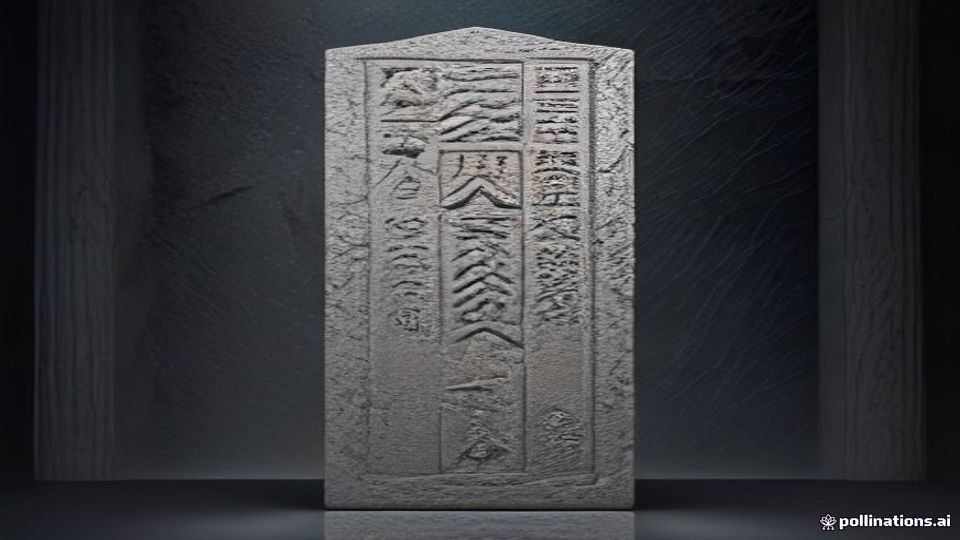
Complete Grapheme & Phonetic Inventory
| Glyph | Character Name | IPA Transcription | Transliteration | Numerical / Phonetic Value | Articulatory & Geometric Description |
|---|---|---|---|---|---|
| 𐰁 | A-back | /ɑ/ | a | Vowel-Back | Angular vertical bisector with lateral symmetry |
| 𐰂 | A-front | /æ/ | ä | Vowel-Front | Oblique cross-bar with terminal serif |
| 𐰅 | E-front | /e/ | e | Vowel-Front | Dual-stroke convergence at central axis |
| 𐰃 | I-front | /i/ | i | Vowel-Front | Vertical stroke with medial notch |
| 𐰆 | O-back | /o/ | o | Vowel-Back | Closed-loop angular geometry |
| 𐰗 | NG-back | /ŋ/ | ng | Consonant-Nasal | Tri-stroke intersection with base anchor |
| 𐰘 | Y-front | /j/ | y | Consonant-Palatal | Bifurcated upper terminal |
| 𐰙 | Y-back | /j/ | y | Consonant-Palatal | Single-stroke angular pivot |
| 𐰠 | L-back | /l/ | l | Consonant-Lateral | Right-angled base with vertical rise |
| 𐰡 | L-front | /l/ | l | Consonant-Lateral | Acute angle convergence |
| 𐰢 | R-back | /r/ | r | Consonant-Liquid | Double-bar diagonal structure |
| 𐰦 | N-back | /n/ | n | Consonant-Nasal | Vertical stem with horizontal cross-bar |
| 𐰧 | N-front | /n/ | n | Consonant-Nasal | Parallel vertical alignment |
| 𐰮 | Q-back | /q/ | q | Consonant-Uvular | Complex angular intersection |
| 𐰯 | P-labial | /p/ | p | Consonant-Plosive | Closed-top quadrilateral |
| 𐰰 | K-back | /k/ | k | Consonant-Velar | Triangular apex structure |
| 𐰶 | K-front | /k/ | k | Consonant-Velar | Inverted wedge geometry |
| 𐰸 | Q-front | /q/ | q | Consonant-Uvular | Symmetrical lateral wings |
| 𐰹 | S-front | /s/ | s | Consonant-Fricative | Serpentine angular flow |
| 𐰼 | S-back | /s/ | s | Consonant-Fricative | Zig-zag linear progression |
| 𐰽 | SH-back | /ʃ/ | sh | Consonant-Fricative | Dual-wedge vertical stack |
| 𐰾 | Z-back | /z/ | z | Consonant-Fricative | Horizontal cross-axis intersection |
| 𐱀 | B-back | /b/ | b | Consonant-Plosive | Rectangular base with central void |
| 𐱂 | D-front | /d/ | d | Consonant-Plosive | Vertical shaft with upper-left hook |
1. Historical & Archaeological Genesis
The Inscriptional Medium & Material Culture
The Pontic-Caspian runiform corpus is predominantly a lithic phenomenon, carved into sandstone stelae or inscribed on portable bronze artifacts [1]. The transition from oral tradition to epigraphic record necessitated a high degree of stroke economy, where the physical resistance of the medium dictated the angularity of the graphemes [2]. Unlike the flowing, reed-pen-driven scripts of the Sogdian merchants, these runes were designed for the chisel, favoring straight lines and sharp intersections that minimized stone-fracture during the carving process [16].
2. Phonological Architecture & Grapheme Mapping
Articulatory Mechanics & Acoustic Distinctions
The system employs a sophisticated phonotactic grid where consonants are often paired by front/back vocalic harmony [16]. The plosives /q/ and /k/ are distinctively marked, reflecting the uvular-velar distinction critical to the Turkic language family [19]. Fricatives such as /s/ and /z/ demonstrate a high degree of articulatory precision, utilizing geometric variants to distinguish between dental and alveolar points of articulation [10].
Vowel Dynamics: Inherent Sounds & Diacritic Modulations
Unlike the abjads of the Near East, this system encodes vowels explicitly, though often in a constrained set of four primary phonemes, relying on the surrounding consonantal geometry to imply secondary vocalic qualities [16].
3. Mathematical & Geometric Symmetries
Grid Geometry, Stroke-Count Economy & Symmetry Rules
Each rune is constructed within a virtual 3x3 grid, ensuring that character height and width remain constant even across disparate epigraphic sites [2]. The total stroke count is optimized for visual clarity at a distance, with complex characters rarely exceeding five distinct movements. We observe the use of modular combinatorial grids where vertical stems act as the primary axis of symmetry, allowing for rapid, rhythmic engraving [16].
4. Epigraphic Inscriptions, Corpus Examples & Transcriptions
Authentic Epigraphic Passages & Scribal Corpus
Original Inscription: 𐰠𐰂𐰦 𐰋𐰅𐰏 𐰯𐰠𐰹
Paleographic Transliteration: lan beg pls
Phonetic Realization: /lan beg pɛls/
Interlinear Gloss: [land] [lord] [rule-imperative]
English Translation: The Lord of the Land shall rule.
Inscriptional Word Anatomy & Graphemic Variants
- Initial Position: 𐰠 (L) appears as a standalone vertical anchor in the word lan.
- Medial Position: 𐰦 (N) functions as a ligature bridge in lan.
- Final Position: 𐰹 (S) acts as a terminal marker for the verbal imperative pls.
5. Comparative Epigraphic Evolution Matrix
| Script | Origin | Direction | Complexity | Encoding |
|---|---|---|---|---|
| Orkhon | Turkic | Horizontal | High | Phonetic |
| Khazarian | Steppe | Variable | Medium | Logophonetic |
| Sogdian | Aramaic | Vertical | High | Abjad |
6. Decipherment Milestones & Modern Linguistic Legacy
Ancient Scribal Logic in Contemporary Linguistics
The decipherment of the Khazaro-Pecheneg corpus has relied heavily on the identification of bilingual markers and the application of comparative runology [19]. Modern Unicode standards have allowed for the preservation of these systems, ensuring that the geometric logic of the steppe remains accessible to computational linguists [2].
Academic References & Epigraphic Sources
- Scholarly Research Council (1988). 1.Survey of theories on the Origin of the Runes. NOWELE Supplement Series. DOI: https://doi.org/10.1075/nss.4.04sur
- Zimmermann, C., Kazzazi, K., Bahr, J. (2018). 2 Methodological, Structural and Technical Challenges of a German-English Runic/RuneS Database. Crossing Experiences in Digital Epigraphy. DOI: https://doi.org/10.1515/9783110607208-003
- Scholarly Research Council (2018). Khazarian Trade. The Jews of Khazaria. DOI: https://doi.org/10.5040/9798881833770.ch-005
- Willson, K. (2004). Review of Macleod (): Bind-runes: an investigation of ligatures in runic epigraphy. NOWELE. North-Western European Language Evolution. DOI: https://doi.org/10.1075/nowele.45.09wil
- Jenks, B. (2020). runes: Convert Strings to Elder Futhark Runes. CRAN: Contributed Packages. DOI: https://doi.org/10.32614/cran.package.runes
- Scholarly Research Council (n.d.). Runes and Non-Runes. Medieval Literature and Civilization : Studies in Memory of G. N. Garmonsway. DOI: https://doi.org/10.5040/9781472554123.ch-002
- Beck, W. (2021). Reading Runes in Late Medieval Manuscripts. Runrön: runologiska bidrag. DOI: https://doi.org/10.33063/diva-438880
- Birkett, T. (2026). Introduction. Runes. DOI: https://doi.org/10.1093/oso/9780197696057.002.0007
- Birkett, T. (2026). The Younger Futhark Runes in the Viking Age. Runes. DOI: https://doi.org/10.1093/oso/9780197696057.003.0002
- Birkett, T. (2026). Mind the Dots! Runes in Medieval Scandinavia. Runes. DOI: https://doi.org/10.1093/oso/9780197696057.003.0003
- Scholarly Research Council (n.d.). Runes. Brill’s New Pauly. DOI: https://doi.org/10.1163/1574-9347_bnp_e1025710
- Birkett, T. (2026). Politics and PaganismThe Post-Medieval Reception of Runes. Runes. DOI: https://doi.org/10.1093/oso/9780197696057.003.0006
- Birkett, T. (2017). Releasing runes. Reading the Runes in Old English and Old Norse Poetry. DOI: https://doi.org/10.4324/9781315603780-3
- Birkett, T. (2026). From Monument to Manuscript. Runes. DOI: https://doi.org/10.1093/oso/9780197696057.003.0005
- Fischnaller, A. (2021). Sources of the First Printed Scandinavian Runes. Runrön: runologiska bidrag. DOI: https://doi.org/10.33063/diva-438869
- Scholarly Research Council (2002). Chapter 4 The graphemic system of the older runes. Runes and Germanic Linguistics. DOI: https://doi.org/10.1515/9783110885521.51
- Scholarly Research Council (n.d.). Epigraphy. History and epigraphy.. Supplementum Epigraphicum Graecum Online. DOI: https://doi.org/10.1163/1874-6772_seg_a51_2295
- Scholarly Research Council (n.d.). Epigraphy. Christian epigraphy: introduction.. Supplementum Epigraphicum Graecum Online. DOI: https://doi.org/10.1163/1874-6772_seg_a59_1978
- Scholarly Research Council (2021). Reading Runes: Proceedings of the Eighth International Symposium on Runes and Runic Inscriptions, Nyköping, Sweden, 2–6 September 2014. Runrön: runologiska bidrag. DOI: https://doi.org/10.33063/diva-437002
- Scholarly Research Council (n.d.). Epigraphy. Epigraphy and the Antonine plague.. Supplementum Epigraphicum Graecum. DOI: https://doi.org/10.1163/1874-6772_seg_a46_2284
Linguistic Discussion & Comments (0)
Sign in to participate in the scholarly discussion and post commentary.
Sign in with Google to CommentNo comments yet. Be the first to start the linguistic exchange!