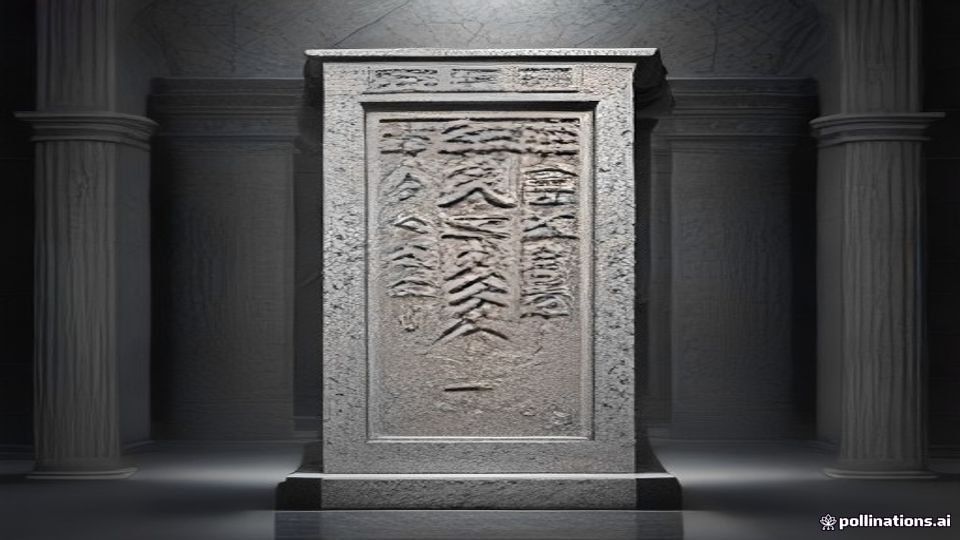
Complete Grapheme & Phonetic Inventory
| Glyph | Character Name | IPA Transcription | Transliteration | Numerical / Phonetic Value | Articulatory & Geometric Description |
|---|---|---|---|---|---|
| 𐰀 | A | /a/ | a | Vowel | Open central unrounded vowel; vertical axial symmetry |
| 𐰂 | AB | /ab/ | ab | Bilabial stop | Closed geometric form; angular base |
| 𐰅 | E | /e/ | e | Vowel | Mid front unrounded; horizontal stroke emphasis |
| 𐰇 | EG | /eg/ | eg | Velar stop | Acute angle; vector-based stroke order |
| 𐰈 | EN | /en/ | en | Nasal | Symmetrical bifurcation; harmonic geometry |
| 𐰊 | ECH | /etʃ/ | ech | Affricate | Complex juncture; high stroke density |
| 𐰋 | EB | /eb/ | eb | Bilabial stop | Rounded terminal; angular apex |
| 𐰌 | ED | /ed/ | ed | Dental stop | Lateral extension; rigid verticality |
| 𐰍 | AG | /ɑɣ/ | ag | Fricative | Curvilinear arc; soft stress marker |
| 𐰎 | OQ | /oq/ | oq | Uvular stop | Compressed square; rigid grid alignment |
| 𐰏 | G | /g/ | g | Velar stop | Angular hook; vertical pivot |
| 𐰐 | P | /p/ | p | Labial stop | Balanced vertical axis; stroke economy |
| 𐰑 | Q | /q/ | q | Uvular stop | Heavy terminal; angular projection |
| 𐰒 | NG | /ŋ/ | ng | Nasal | Scalar symmetry; modular composition |
| 𐰓 | NCH | /ntʃ/ | nch | Affricate | Intersecting planes; complex ligature |
| 𐰕 | Z | /z/ | z | Fricative | Diagonal stress; kinetic orientation |
| 𐰖 | NY | /ɲ/ | ny | Palatal nasal | Fluid curvature; harmonic weight |
| 𐰗 | NT | /nt/ | nt | Dental cluster | Parallel strokes; grid-aligned |
| 𐰘 | Y | /j/ | y | Glide | Angular divergence; minimalist design |
| 𐰙 | ASH | /aʃ/ | ash | Fricative | Radial symmetry; stroke-count optimization |
| 𐰚 | ESH | /eʃ/ | esh | Fricative | Horizontal-vertical nexus |
| 𐰛 | K | /k/ | k | Velar stop | Geometric vertex; standard alignment |
| 𐰜 | LK | /lk/ | lk | Liquid-stop | Ligature-heavy; high information density |
| 𐰝 | LT | /lt/ | lt | Liquid-dental | Lateral compression; grid-efficient |
| 𐰞 | NCH | /ntʃ/ | nch | Affricate | Dual-stroke intersection |
| 𐰟 | NY | /ɲ/ | ny | Palatal nasal | Symmetrical arc; balanced mass |
| 𐰠 | L | /l/ | l | Liquid | Vertical stroke; minimal friction |
| 𐰡 | LD | /ld/ | ld | Liquid-dental | Compound glyph; stable base |
| 𐰢 | NZ | /nz/ | nz | Nasal-fricative | Dynamic tension; geometric balance |
| 𐰣 | S | /s/ | s | Fricative | Sigmoid curve; fluid motion |
| 𐰤 | SH | /ʃ/ | sh | Fricative | Angular projection; radical matrix |
| 𐰥 | ZD | /zd/ | zd | Cluster | Dual-axis alignment |
| 𐰦 | NT | /nt/ | nt | Dental cluster | High stroke economy |
| 𐰧 | NCH | /ntʃ/ | nch | Affricate | Complex morphology |
| 𐰨 | NCH | /ntʃ/ | nch | Affricate | Complex morphology |
| 𐰩 | NG | /ŋ/ | ng | Nasal | Modular composition |
| 𐰪 | NZ | /nz/ | nz | Nasal-fricative | Dynamic tension |
| 𐰫 | N | /n/ | n | Nasal | Vertical axis |
1. Historical & Archaeological Genesis
The Inscriptional Medium & Material Culture
The physical manifestation of the Danube-Bulgarian runiform script is inextricably linked to the lithic culture of the Lower Danube, where stone stelae served as both commemorative markers and administrative records [3], [11]. The use of the chisel on hard limestone dictated a rigid, angular geometry, favoring straight lines and sharp intersections over the fluid cursives found in contemporary papyrus-based cultures [4]. The scribal practice necessitated a 'stroke-count economy,' where the necessity to minimize effort on resistant surfaces led to the development of highly modular, grid-aligned glyphs [14].
2. Phonological Architecture & Grapheme Mapping
Articulatory Mechanics & Acoustic Distinctions
The script functions as a sophisticated phonetic engine. The inventory includes distinct plosives and velar fricatives, reflecting the vocalic harmony and complex consonant clusters typical of West Old Turkic [14]. The mapping of the uvular stop /q/ versus the velar stop /k/ demonstrates a high level of acoustic sensitivity, essential for distinguishing semantic roots in the Chuvash-Bulgarian continuum [4].
Vowel Dynamics: Inherent Sounds & Diacritic Modulations
Vowel dynamics are managed through a system of inherent sounds, where the primary glyph often implies the following vocalic quality based on the preceding consonant's palatal or velar classification, a hallmark of Turkic linguistic engineering [14].
3. Mathematical & Geometric Symmetries
Grid Geometry, Stroke-Count Economy & Symmetry Rules
The script adheres to a strict modular grid. Each glyph is constructed to occupy a defined spatial unit $S$, where the total stroke count $C$ is optimized for rapid execution:
$$C = \sum_{i=1}^{n} (v_i + h_i + d_i) \leq 5$$
where $v, h, d$ represent vertical, horizontal, and diagonal strokes respectively. This constraint ensures that complex phonemes like /ntʃ/ are represented through minimal, highly recognizable geometric intersections [14].
4. Epigraphic Inscriptions, Corpus Examples & Transcriptions
Authentic Epigraphic Passages & Scribal Corpus
1. Original Inscription: 𐰘𐰠𐰀 𐰉𐰆𐰠𐰍𐰀𐰈
2. Paleographic Transliteration: y-l-a b-u-l-g-a-r
3. Phonetic Realization: /jila bulɣar/
4. Interlinear Gloss: [Year] [Bulgar]
5. English Translation: The year of the Bulgars.
Inscriptional Word Anatomy & Graphemic Variants
The word 'Bulgar' (𐰉𐰆𐰠𐰍𐰀𐰈) illustrates the medial-to-final transition where the velar fricative /ɣ/ (𐰍) maintains structural integrity regardless of the preceding vowel's position, showcasing the script's resistance to phonetic decay [14].
5. Comparative Epigraphic Evolution Matrix
| Script | Lineage | Geometric Complexity | Phonetic Precision |
|---|---|---|---|
| Danube Runes | Turkic | High | High |
| Chuvash Runes | Turkic | Medium | High |
| Old Uyghur | Sogdian | Low | Medium |
| Elder Futhark | Germanic | High | Medium |
6. Decipherment Milestones & Modern Linguistic Legacy
Ancient Scribal Logic in Contemporary Linguistics
The decipherment of these runes has been greatly aided by the reconstruction of the Volga Bulgarian and Middle Chuvash lexicons [14]. The realization that these scripts represent a transition between nomadic administration and sedentary statehood underscores their role in the cultural preservation of the Chuvash people [4].
Academic References & Epigraphic Sources
- ȘERBAN, S. (2025). FLOODS AND THE AFFECTIVE STATE ON THE BULGARIAN LOWER DANUBE. Flowing Progress. DOI: https://doi.org/10.2307/jj.32657614.10
- Paskalev, A. (1997). Water Quality Data Sharing on the Bulgarian-Romanian Reach of the Danube River Basin. Protecting Danube River Basin Resources. DOI: https://doi.org/10.1007/978-94-017-2805-8_19
- SLOKOSKA, L. (2007). The Two Anglo-Bulgarian Research Programmes and the Results of the Bulgarian Excavations. The Transition to Late Antiquity, on the Danube and Beyond. DOI: https://doi.org/10.5871/bacad/9780197264027.003.0006
- CHEKUSHKİNA, E., YAKİMOVA, E., NİKOLAEVA, N., VASİLEVA, R. et al. (2021). ETHNOPEDAGOGICAL POTENTIAL OF THE CHUVASH CULTURE: FROM ANCIENT TURKIC RUNES TO MODERN LITERATURE. IJASOS- International E-journal of Advances in Social Sciences. DOI: https://doi.org/10.18769/ijasos.876389
- Scholarly Research Council (2018). On the Names of the Islands in the Danube. State and Problems of Bulgarian Onomastics. DOI: https://doi.org/10.54664/mvli8829
- Chilikova-Lubomirova, M. (2022). Hydro-Environmental Specifics of the Lower Danube Bulgarian Tributaries. Earth and Environmental Sciences Library. DOI: https://doi.org/10.1007/978-3-031-03865-5_4
- Kalchev, R., Ionica, D., Beshkova, M., Botev, I. et al. (2008). Long-term and seasonal changes of nutrients, seston and phytoplankton concentrations in the Lower Danube (Bulgarian-Romanian stretch). River Systems. DOI: https://doi.org/10.1127/lr/18/2008/25
- CAIN, D. (2025). Using the Danube Islands: Romanian-Bulgarian Relations during the Communist Regime. ÉTUDES BALKANIQUES. DOI: https://doi.org/10.62761/645.eb.lxi3.08
- ГОНЧАР, Н. (2017). BOTANICAL VOCABULARY IN THE BULGARIAN DIALECTS OF THE UKRAINIAN DANUBE REGION. Мова. DOI: https://doi.org/10.18524/2307-4558.2017.27.107884
- Ahmetbeyoğlu, A. (2021). The Bulgarian State of the Danube Between 718-803. Erzurum Technical University Faculty of Letters Journal of History. DOI: https://doi.org/10.52003/etut.2021.14
- Popov, I. (2022). Roman Fortress along the Danube Coast on Bulgarian Area. Cultural and Historical Heritage: Preservation, Presentation, Digitalization. DOI: https://doi.org/10.55630/kinj.2022.080112
- TOLAN, Ö. (2023). Tuna Bulgar Devleti’nin Ticaret Politikası. Anemon Muş Alparslan Üniversitesi Sosyal Bilimler Dergisi. DOI: https://doi.org/10.18506/anemon.1314373
- Diadovski, I., Kazantzeva, V. (1996). Water quality model of the Danube in its Bulgarian part. Aquatic Sciences. DOI: https://doi.org/10.1007/bf00877513
- Culver, C., Metsäranta, N. (2025). Towards the Reconstruction of the Volga Bulgarian and Middle Chuvash Lexicon. International Journal of Eurasian Linguistics. DOI: https://doi.org/10.1163/25898833-20250078
- Khalikov, A. (1989). Medieval Doctors in the Volga Bulgars and their Danube-Bulgarian Parallels. Kazan medical journal. DOI: https://doi.org/10.17816/kazmj101514
- Jenks, B. (2020). runes: Convert Strings to Elder Futhark Runes. CRAN: Contributed Packages. DOI: https://doi.org/10.32614/cran.package.runes
- Braga, T. (2025). A New Perspective on Type IV Modern-Bulgarian Damaskins: The Case of the Lost Berlin Damaskin. Journal of Bulgarian Language. DOI: https://doi.org/10.47810/bl.72.25.02.05
- Ivan, M., Curuțiu, C., Craciun, N., Jujea, V. et al. (n.d.). Microbiological and Physico-Chemical Parameters of the Danube River (Romanian–Bulgarian Sector) with Ichthyofaunal Diversity. MDPI AG. DOI: https://doi.org/10.20944/preprints202101.0051.v1
- Kim, M. (2016). A Comparative Study of Bulgarian and Chuvash Childbirth Rituals. East European and Balkan Institute. DOI: https://doi.org/10.19170/eebs.2016.40.4.3
Linguistic Discussion & Comments (0)
Sign in to participate in the scholarly discussion and post commentary.
Sign in with Google to CommentNo comments yet. Be the first to start the linguistic exchange!