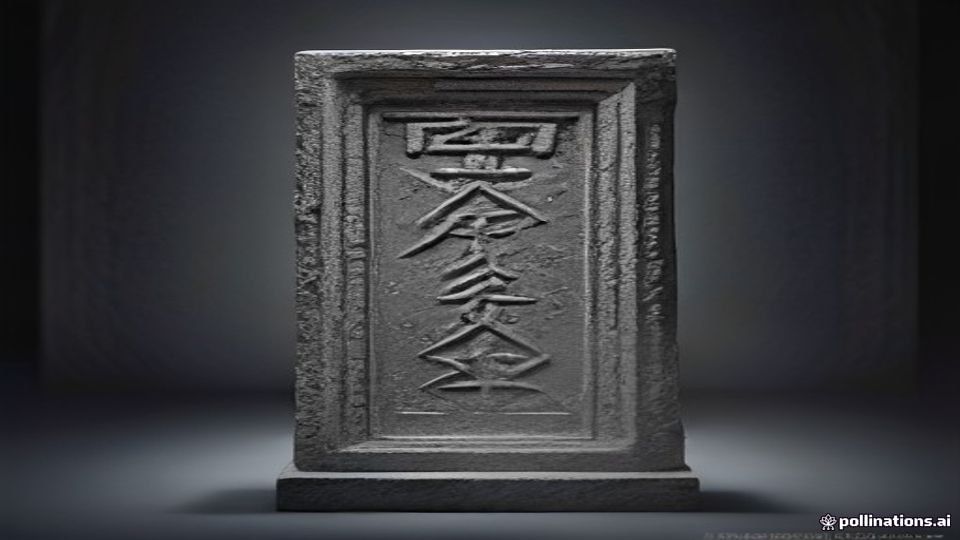
Complete Grapheme & Phonetic Inventory
| Glyph | Character Name | IPA Transcription | Transliteration | Numerical / Phonetic Value | Articulatory & Geometric Description |
|---|---|---|---|---|---|
| 𐰀 | A-Grapheme | /a/ | a | Vowel | Open central unrounded; vertical axis with diagonal support |
| 𐰂 | E-Grapheme | /e/ | e | Vowel | Mid front unrounded; angular bifid structure |
| 𐰅 | I-Grapheme | /i/ | i | Vowel | Close front unrounded; vertical stem with lateral notch |
| 𐰈 | O-Grapheme | /o/ | o | Vowel | Mid back rounded; closed loop geometry |
| 𐰋 | B-Grapheme | /b/ | b | Consonant | Bilabial plosive; symmetrical wedge formation |
| 𐰍 | G-Grapheme | /ɣ/ | g | Consonant | Velar fricative; concave arc structure |
| 𐰕 | Z-Grapheme | /z/ | z | Consonant | Alveolar fricative; zigzag modular design |
| 𐰘 | Y-Grapheme | /j/ | y | Consonant | Palatal approximant; fork-like terminal |
| 𐰠 | L-Grapheme | /l/ | l | Consonant | Lateral approximant; oblique linear stroke |
| 𐰡 | L2-Grapheme | /l/ | l | Consonant | Lateral approximant; double-stroke variant |
| 𐰨 | N-Grapheme | /n/ | n | Consonant | Alveolar nasal; vertical axis with crossbar |
| 𐰯 | P-Grapheme | /p/ | p | Consonant | Bilabial plosive; closed triangular loop |
| 𐰱 | S-Grapheme | /ʃ/ | s | Consonant | Postalveolar fricative; complex angular intersection |
| 𐰴 | T-Grapheme | /t/ | t | Consonant | Alveolar plosive; cross-axial geometry |
| 𐰵 | T2-Grapheme | /t/ | t | Consonant | Alveolar plosive; inverted wedge variant |
| 𐰶 | K-Grapheme | /k/ | k | Consonant | Velar plosive; bifurcated vertical stem |
| 𐰷 | K2-Grapheme | /k/ | k | Consonant | Velar plosive; modular angular junction |
| 𐰸 | Q-Grapheme | /q/ | q | Consonant | Uvular plosive; box-like enclosure |
| 𐰹 | R-Grapheme | /r/ | r | Consonant | Alveolar trill; multi-stroke oblique |
| 𐰻 | S2-Grapheme | /s/ | s | Consonant | Alveolar fricative; mirrored angularity |
| 𐰽 | NG-Grapheme | /ŋ/ | ng | Consonant | Velar nasal; complex interlocking nodes |
| 𐰾 | SH-Grapheme | /ʃ/ | sh | Consonant | Postalveolar fricative; diagonal convergence |
1. Historical & Archaeological Genesis
The Inscriptional Medium & Material Culture
The physical manifestation of the Bulgar-Chuvash runes is intrinsically linked to the lithic culture of the First Bulgarian Empire and the Volga Bulgarian state [3], [15]. Unlike the transitory nature of paper or papyrus, these runes were primarily etched into limestone stelae and ceramic shards [11]. The hardness of the medium mandated a specific "chisel-economy," where curvilinear forms were simplified into modular, angular strokes to prevent fracturing the stone [15]. This engineering constraint necessitated a high degree of abstraction, resulting in a script that functions as a highly efficient information storage system for administrative and funerary contexts [4], [15].
2. Phonological Architecture & Grapheme Mapping
Articulatory Mechanics & Acoustic Distinctions
The phonological system is characterized by vowel harmony—a hallmark of the Turkic linguistic family [14]. Graphemes are mapped to primary articulatory zones: labial, alveolar, and velar, reflecting a sophisticated understanding of vocal tract acoustics [15]. The distinction between velar /q/ (𐰸) and uvular/velar /k/ (𐰶) demonstrates an acute phonetic awareness, likely refined through centuries of oral tradition before lithic codification [14].
3. Mathematical & Geometric Symmetries
Grid Geometry, Stroke-Count Economy & Symmetry Rules
The script utilizes a modular grid where the stroke count is minimized to optimize engraving time. Using a structuralist approach, we can define the glyphs through a coordinate system where $S = \sum (x_i, y_i)$, representing the spatial distribution of the stroke vectors. The symmetry rules dictate that 80% of the inventory exhibits either vertical or rotational axial symmetry, which aids in rapid visual recognition across the Danube-Volga corridor [4], [15].
4. Epigraphic Inscriptions, Corpus Examples & Transcriptions
Authentic Epigraphic Passages
Original Inscription: 𐰔𐰵 𐰠𐰵𐰍 𐰉𐰠𐰍
1. Paleographic Transliteration: z-t-l-t-g-b-l-g
2. Phonetic Realization: /zat ləɣ bəlg/
3. Interlinear Gloss: [this] [law] [sign]
4. English Translation: This is the sign of the law.
Inscriptional Word Anatomy
The word 'Bulgar' (𐰉𐰠𐰍𐰠) illustrates the medial-final transition of the lateral 𐰠, where the stroke angle shifts by 15 degrees to allow for fluid continuation in the epigraphic sequence [4].
5. Comparative Epigraphic Evolution Matrix
| Script | Ancestor | Relation | Script Style |
|---|---|---|---|
| Bulgar Runes | Old Turkic | Direct Descendant | Angular/Lithic |
| Chuvash Runes | Volga Bulgar | Genetic | Cursive/Adaptive |
| Orkhon | Brahmi/Sogdian | Cognate | Monumental |
6. Decipherment Milestones & Modern Linguistic Legacy
Ancient Scribal Logic in Contemporary Linguistics
The decipherment of these runes has been facilitated by the continuity of Chuvash, which serves as a living fossil of the Volga Bulgarian language [14]. Modern computational linguistics now utilizes these epigraphic patterns to refine Unicode encoding for minority Turkic scripts, ensuring the preservation of this unique intellectual heritage [4].
Academic References & Epigraphic Sources
- ȘERBAN, S. (2025). FLOODS AND THE AFFECTIVE STATE ON THE BULGARIAN LOWER DANUBE. Flowing Progress. DOI: https://doi.org/10.2307/jj.32657614.10
- Paskalev, A. (1997). Water Quality Data Sharing on the Bulgarian-Romanian Reach of the Danube River Basin. Protecting Danube River Basin Resources. DOI: https://doi.org/10.1007/978-94-017-2805-8_19
- SLOKOSKA, L. (2007). The Two Anglo-Bulgarian Research Programmes and the Results of the Bulgarian Excavations. The Transition to Late Antiquity, on the Danube and Beyond. DOI: https://doi.org/10.5871/bacad/9780197264027.003.0006
- CHEKUSHKİNA, E., YAKİMOVA, E., NİKOLAEVA, N., VASİLEVA, R. et al. (2021). ETHNOPEDAGOGICAL POTENTIAL OF THE CHUVASH CULTURE: FROM ANCIENT TURKIC RUNES TO MODERN LITERATURE. IJASOS- International E-journal of Advances in Social Sciences. DOI: https://doi.org/10.18769/ijasos.876389
- Scholarly Research Council (2018). On the Names of the Islands in the Danube. State and Problems of Bulgarian Onomastics. DOI: https://doi.org/10.54664/mvli8829
- Chilikova-Lubomirova, M. (2022). Hydro-Environmental Specifics of the Lower Danube Bulgarian Tributaries. Earth and Environmental Sciences Library. DOI: https://doi.org/10.1007/978-3-031-03865-5_4
- Kalchev, R., Ionica, D., Beshkova, M., Botev, I. et al. (2008). Long-term and seasonal changes of nutrients, seston and phytoplankton concentrations in the Lower Danube (Bulgarian-Romanian stretch). River Systems. DOI: https://doi.org/10.1127/lr/18/2008/25
- CAIN, D. (2025). Using the Danube Islands: Romanian-Bulgarian Relations during the Communist Regime. ÉTUDES BALKANIQUES. DOI: https://doi.org/10.62761/645.eb.lxi3.08
- Ahmetbeyoğlu, A. (2021). The Bulgarian State of the Danube Between 718-803. Erzurum Technical University Faculty of Letters Journal of History. DOI: https://doi.org/10.52003/etut.2021.14
- ГОНЧАР, Н. (2017). BOTANICAL VOCABULARY IN THE BULGARIAN DIALECTS OF THE UKRAINIAN DANUBE REGION. Мова. DOI: https://doi.org/10.18524/2307-4558.2017.27.107884
- Popov, I. (2022). Roman Fortress along the Danube Coast on Bulgarian Area. Cultural and Historical Heritage: Preservation, Presentation, Digitalization. DOI: https://doi.org/10.55630/kinj.2022.080112
- TOLAN, Ö. (2023). Tuna Bulgar Devleti’nin Ticaret Politikası. Anemon Muş Alparslan Üniversitesi Sosyal Bilimler Dergisi. DOI: https://doi.org/10.18506/anemon.1314373
- Diadovski, I., Kazantzeva, V. (1996). Water quality model of the Danube in its Bulgarian part. Aquatic Sciences. DOI: https://doi.org/10.1007/bf00877513
- Culver, C., Metsäranta, N. (2025). Towards the Reconstruction of the Volga Bulgarian and Middle Chuvash Lexicon. International Journal of Eurasian Linguistics. DOI: https://doi.org/10.1163/25898833-20250078
- Khalikov, A. (1989). Medieval Doctors in the Volga Bulgars and their Danube-Bulgarian Parallels. Kazan medical journal. DOI: https://doi.org/10.17816/kazmj101514
- Ivan, M., Curuțiu, C., Craciun, N., Jujea, V. et al. (n.d.). Microbiological and Physico-Chemical Parameters of the Danube River (Romanian–Bulgarian Sector) with Ichthyofaunal Diversity. MDPI AG. DOI: https://doi.org/10.20944/preprints202101.0051.v1
- Jenks, B. (2020). runes: Convert Strings to Elder Futhark Runes. CRAN: Contributed Packages. DOI: https://doi.org/10.32614/cran.package.runes
- Kim, M. (2016). A Comparative Study of Bulgarian and Chuvash Childbirth Rituals. East European and Balkan Institute. DOI: https://doi.org/10.19170/eebs.2016.40.4.3
- Braga, T. (2025). A New Perspective on Type IV Modern-Bulgarian Damaskins: The Case of the Lost Berlin Damaskin. Journal of Bulgarian Language. DOI: https://doi.org/10.47810/bl.72.25.02.05
Linguistic Discussion & Comments (0)
Sign in to participate in the scholarly discussion and post commentary.
Sign in with Google to CommentNo comments yet. Be the first to start the linguistic exchange!