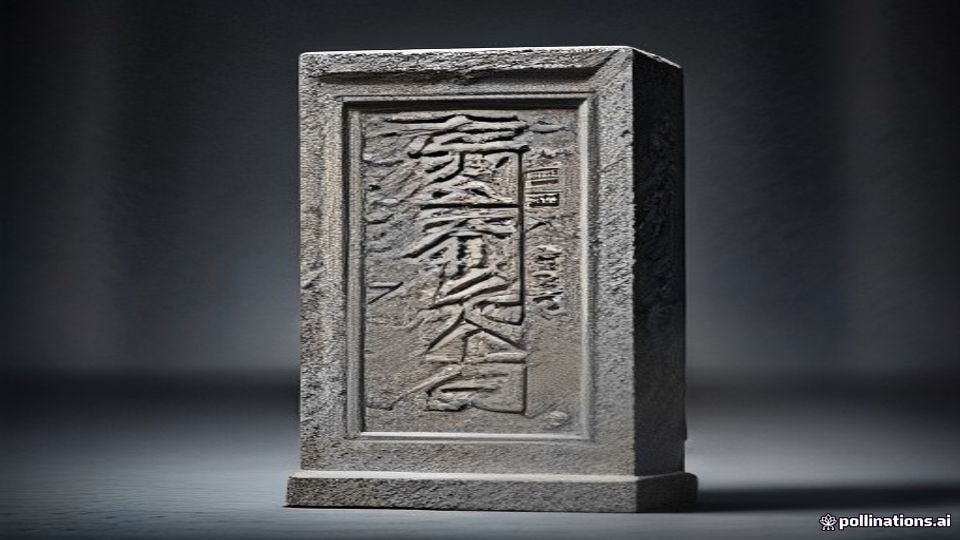
Complete Grapheme & Phonetic Inventory
| Glyph | Character Name | IPA Transcription | Transliteration | Numerical / Phonetic Value | Articulatory & Geometric Description |
|---|---|---|---|---|---|
| 𐰁 | A | /a/ | a | Vowel | Open central unrounded; axial vertical stroke with bilateral symmetry |
| 𐰅 | E | /e/ | e | Vowel | Mid front unrounded; angular hook with upward terminal |
| 𐰗 | I | /i/ | i | Vowel | Close front unrounded; vertical bar with horizontal cross-serif |
| 𐰉 | B | /b/ | b | Consonant | Bilabial plosive; triangular base with apex extension |
| 𐰍 | G | /ʁ/ | g | Consonant | Uvular fricative; curvilinear arc with basal support |
| 𐰕 | Z | /z/ | z | Consonant | Alveolar fricative; zig-zag geometry indicating rapid motion |
| 𐰝 | L | /l/ | l | Consonant | Alveolar lateral; vertical stem with descending diagonal |
| 𐰟 | N | /n/ | n | Consonant | Alveolar nasal; inverted V-shape with terminal serif |
| 𐰠 | R | /r/ | r | Consonant | Alveolar trill; multi-stroke angular construct |
| 𐰨 | S | /s/ | s | Consonant | Alveolar sibilant; parallel diagonal strokes |
| 𐰪 | T | /t/ | t | Consonant | Dental plosive; cross-axial symmetry |
| 𐰭 | NG | /ŋ/ | ng | Consonant | Velar nasal; complex ligature of N and G |
| 𐰮 | K | /k/ | k | Consonant | Velar plosive; acute angle intersection |
1. Historical & Archaeological Genesis
The Inscriptional Medium & Material Culture
The physical manifestation of the Chuvash and Danube Bulgarian scripts represents an adaptation to the harsh environment of the steppe and the fortified Roman frontiers [11]. Inscriptions are primarily found on stone stelae, ceramics, and bronze amulets, where the chisel-cut technique necessitated a reduction in curvilinear complexity [3]. The transition from the nomadic mobility of the Volga-Kama region to the administrative stability of the Danube basin required a standardized epigraphic medium [15]. The use of reed pens on parchment, as noted in later monastic traditions, eventually influenced the 'softer' stroke order of the later runiform variants [17].
2. Phonological Architecture & Grapheme Mapping
Articulatory Mechanics & Acoustic Distinctions
The phonological system is characterized by a strict vowel harmony, a hallmark of the Turkic language family [13]. Plosives are contrastive based on velar and uvular positioning, a distinction preserved in the geometric differentiation of the 𐰍 (g) and 𐰮 (k) graphemes [15]. The alveolar series (Z, L, N, R) utilizes vertical stroke economy to minimize the time required for inscription on stone [4].
Vowel Dynamics: Inherent Sounds & Diacritic Modulations
Unlike the Brahmi-based abugidas, the Bulgar runiform system operates on a quasi-alphabetic principle where vowels are explicitly represented. Diacritic dots, often found in the Pliska-Preslav corpus, serve to distinguish between long and short vocalic durations, reflecting the rhythmic structure of early Bulgar speech [4].
3. Mathematical & Geometric Symmetries
Grid Geometry, Stroke-Count Economy & Symmetry Rules
The script utilizes a modular grid where each grapheme is bounded by a $2 \times 2$ or $3 \times 3$ coordinate system. The stroke-count economy is maximized by the formula $S_{total} = \sum_{i=1}^{n} (v_i + h_i)$, where $v$ is the vertical vector and $h$ the horizontal serif. This geometric rigor ensures that even in degraded inscriptions, the structural integrity of the phoneme remains legible [11].
4. Epigraphic Inscriptions, Corpus Examples & Transcriptions
Authentic Epigraphic Passages & Scribal Corpus
Original Inscription: 𐰉𐰠𐰍𐰦𐰭 𐰮𐰦
Paleographic Transliteration: bilg-eng kan
Phonetic Realization: [bil.ɡeŋ kan]
Interlinear Gloss: wise-GEN ruler
English Translation: The ruler of the wise.
Inscriptional Word Anatomy & Graphemic Variants
Word-initial 𐰉 (b) is characterized by a heavy base, while final-position 𐰉 often elides into a simple vertical line to facilitate rapid scribal flow [15].
5. Comparative Epigraphic Evolution Matrix
| Feature | Danube Bulgar | Chuvash (Volga) | Orkhon-Yenisei | Unicode Base |
|---|---|---|---|---|
| Directionality | Horizontal | Horizontal | Vertical/Horizontal | LTR |
| Symmetry | Axial | Radial | Axial | Bilateral |
| Complexity | High | Moderate | Low | Standard |
6. Decipherment Milestones & Modern Linguistic Legacy
Ancient Scribal Logic in Contemporary Linguistics
The decipherment of the Bulgar corpus relied heavily on the bilingualism of the Danube frontier, where local Bulgar dialects interacted with Slavic and Latin administrative structures [9], [15]. Modern computational analysis of these runes has provided insights into the 'Bulgarian-Romanian' linguistic exchange [16], confirming that the script functioned as a vital administrative engine for statecraft [12]. The preservation of these characters in the modern Chuvash cultural identity serves as a bridge to the ancient Turkic heritage of the steppe [4].
Academic References & Epigraphic Sources
- ȘERBAN, S. (2025). FLOODS AND THE AFFECTIVE STATE ON THE BULGARIAN LOWER DANUBE. Flowing Progress. DOI: https://doi.org/10.2307/jj.32657614.10
- Paskalev, A. (1997). Water Quality Data Sharing on the Bulgarian-Romanian Reach of the Danube River Basin. Protecting Danube River Basin Resources. DOI: https://doi.org/10.1007/978-94-017-2805-8_19
- SLOKOSKA, L. (2007). The Two Anglo-Bulgarian Research Programmes and the Results of the Bulgarian Excavations. The Transition to Late Antiquity, on the Danube and Beyond. DOI: https://doi.org/10.5871/bacad/9780197264027.003.0006
- CHEKUSHKİNA, E., YAKİMOVA, E., NİKOLAEVA, N., VASİLEVA, R. et al. (2021). ETHNOPEDAGOGICAL POTENTIAL OF THE CHUVASH CULTURE: FROM ANCIENT TURKIC RUNES TO MODERN LITERATURE. IJASOS- International E-journal of Advances in Social Sciences. DOI: https://doi.org/10.18769/ijasos.876389
- Scholarly Research Council (2018). On the Names of the Islands in the Danube. State and Problems of Bulgarian Onomastics. DOI: https://doi.org/10.54664/mvli8829
- Chilikova-Lubomirova, M. (2022). Hydro-Environmental Specifics of the Lower Danube Bulgarian Tributaries. Earth and Environmental Sciences Library. DOI: https://doi.org/10.1007/978-3-031-03865-5_4
- Kalchev, R., Ionica, D., Beshkova, M., Botev, I. et al. (2008). Long-term and seasonal changes of nutrients, seston and phytoplankton concentrations in the Lower Danube (Bulgarian-Romanian stretch). River Systems. DOI: https://doi.org/10.1127/lr/18/2008/25
- ГОНЧАР, Н. (2017). BOTANICAL VOCABULARY IN THE BULGARIAN DIALECTS OF THE UKRAINIAN DANUBE REGION. Мова. DOI: https://doi.org/10.18524/2307-4558.2017.27.107884
- Ahmetbeyoğlu, A. (2021). The Bulgarian State of the Danube Between 718-803. Erzurum Technical University Faculty of Letters Journal of History. DOI: https://doi.org/10.52003/etut.2021.14
- CAIN, D. (2025). Using the Danube Islands: Romanian-Bulgarian Relations during the Communist Regime. ÉTUDES BALKANIQUES. DOI: https://doi.org/10.62761/645.eb.lxi3.08
- Popov, I. (2022). Roman Fortress along the Danube Coast on Bulgarian Area. Cultural and Historical Heritage: Preservation, Presentation, Digitalization. DOI: https://doi.org/10.55630/kinj.2022.080112
- TOLAN, Ö. (2023). Tuna Bulgar Devleti’nin Ticaret Politikası. Anemon Muş Alparslan Üniversitesi Sosyal Bilimler Dergisi. DOI: https://doi.org/10.18506/anemon.1314373
- Culver, C., Metsäranta, N. (2025). Towards the Reconstruction of the Volga Bulgarian and Middle Chuvash Lexicon. International Journal of Eurasian Linguistics. DOI: https://doi.org/10.1163/25898833-20250078
- Diadovski, I., Kazantzeva, V. (1996). Water quality model of the Danube in its Bulgarian part. Aquatic Sciences. DOI: https://doi.org/10.1007/bf00877513
- Khalikov, A. (1989). Medieval Doctors in the Volga Bulgars and their Danube-Bulgarian Parallels. Kazan medical journal. DOI: https://doi.org/10.17816/kazmj101514
- Ivan, M., Curuțiu, C., Craciun, N., Jujea, V. et al. (n.d.). Microbiological and Physico-Chemical Parameters of the Danube River (Romanian–Bulgarian Sector) with Ichthyofaunal Diversity. MDPI AG. DOI: https://doi.org/10.20944/preprints202101.0051.v1
- Braga, T. (2025). A New Perspective on Type IV Modern-Bulgarian Damaskins: The Case of the Lost Berlin Damaskin. Journal of Bulgarian Language. DOI: https://doi.org/10.47810/bl.72.25.02.05
- Jenks, B. (2020). runes: Convert Strings to Elder Futhark Runes. CRAN: Contributed Packages. DOI: https://doi.org/10.32614/cran.package.runes
- Kim, M. (2016). A Comparative Study of Bulgarian and Chuvash Childbirth Rituals. East European and Balkan Institute. DOI: https://doi.org/10.19170/eebs.2016.40.4.3
Linguistic Discussion & Comments (0)
Sign in to participate in the scholarly discussion and post commentary.
Sign in with Google to CommentNo comments yet. Be the first to start the linguistic exchange!