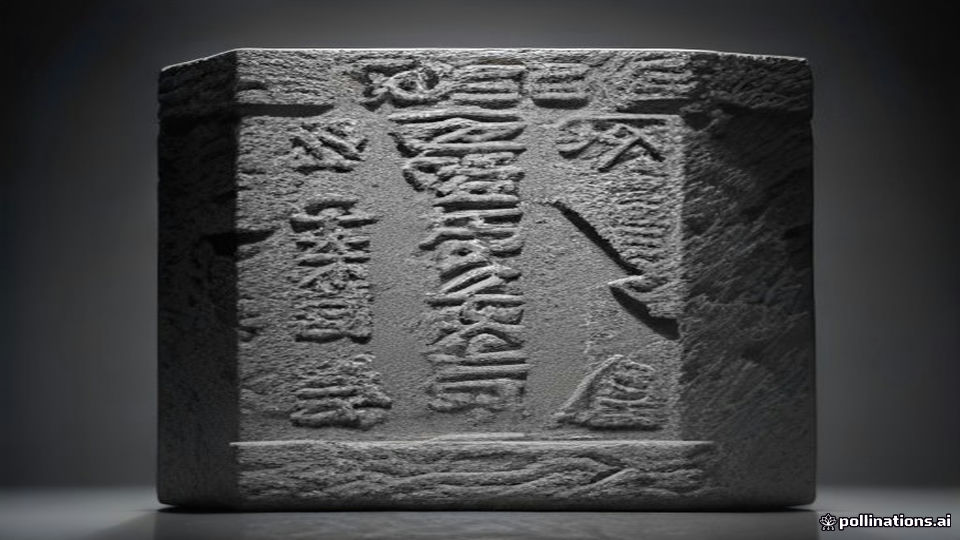
Complete Grapheme & Phonetic Inventory
| Glyph | Character Name | IPA Transcription | Transliteration | Numerical / Phonetic Value | Articulatory & Geometric Description |
|---|---|---|---|---|---|
| 𐰁 | Ka-1 | /k/ | k | Velar Plosive | Angular vertical stem with dual oblique arms |
| 𐰂 | Ka-2 | /k/ | k | Velar Plosive | Mirrored variant for back-vowel harmony |
| 𐰃 | Ga-1 | /g/ | g | Voiced Velar Plosive | Asymmetric chevron with central pivot |
| 𐰄 | Ga-2 | /g/ | g | Voiced Velar Plosive | Geometric inversion for vowel context |
| 𐰅 | E-1 | /e/ | e | Front Vowel | Vertical bar with medial horizontal stroke |
| 𐰆 | E-2 | /e/ | e | Front Vowel | Stylized ligature for rapid carving |
| 𐰇 | A-1 | /a/ | a | Open Central Vowel | Triangular base with vertical axis |
| 𐰈 | A-2 | /a/ | a | Open Central Vowel | Open-top geometric configuration |
| 𐰉 | Ba-1 | /b/ | b | Bilabial Plosive | Quadrilateral frame with central void |
| 𐰊 | Ba-2 | /b/ | b | Bilabial Plosive | Compressed rectangular form |
| 𐰋 | Da-1 | /d/ | d | Alveolar Plosive | Hooked terminal with vertical descent |
| 𐰌 | Da-2 | /d/ | d | Alveolar Plosive | Inverse hook for harmony |
| 𐰍 | Og-1 | /ʁ/ | ğ | Velar Fricative | Symmetrical chevron with extended tail |
| 𐰎 | Og-2 | /ʁ/ | ğ | Velar Fricative | Compressed angular variant |
| 𐰏 | Ng-1 | /ŋ/ | ŋ | Velar Nasal | Double-curved angular stroke |
| 𐰐 | Ng-2 | /ŋ/ | ŋ | Velar Nasal | Simplified single-stroke variant |
| 𐰑 | O-1 | /o/ | o | Rounded Vowel | Circular geometric construct |
| 𐰒 | U-1 | /u/ | u | Rounded Vowel | Angular U-shape |
| 𐰓 | I-1 | /i/ | i | Close Front Vowel | Linear vertical with cross-tick |
| 𐰔 | Sa-1 | /s/ | s | Alveolar Fricative | Zig-zag geometric progression |
| 𐰕 | Sa-2 | /s/ | s | Alveolar Fricative | Simplified oblique stroke |
| 𐰖 | Sh-1 | /ʃ/ | ş | Postalveolar Fricative | Bifurcated terminal |
| 𐰗 | L-1 | /l/ | l | Lateral Approximant | Vertical staff with lateral hook |
| 𐰘 | Y-1 | /j/ | y | Palatal Approximant | Multi-stroke convergence |
| 𐰙 | Nt-1 | /nt/ | nt | Nasal-Plosive Cluster | Complex ligature construct |
| 𐰚 | Nd-1 | /nd/ | nd | Nasal-Plosive Cluster | Compressed ligature |
| 𐰛 | Q-1 | /q/ | q | Uvular Plosive | High-frequency angular glyph |
| 𐰜 | Q-2 | /q/ | q | Uvular Plosive | Mirror-image variant |
| 𐰝 | Ic-1 | /itʃ/ | ic | Affricate Cluster | Complex geometric intersection |
| 𐰞 | Nch-1 | /ntʃ/ | nç | Nasal-Affricate Cluster | Dense stroke-count ligature |
| 𐰟 | M-1 | /m/ | m | Bilabial Nasal | Triple-vertical parallel bars |
| 𐰠 | L-2 | /l/ | l | Lateral Approximant | Inverted L-shape |
| 𐰡 | Lt-1 | /lt/ | lt | Lateral-Plosive Cluster | Ligated vertical-oblique |
| 𐰢 | Nch-2 | /ntʃ/ | nç | Nasal-Affricate Cluster | Simplified ligature |
| 𐰣 | R-1 | /r/ | r | Alveolar Trill | Vertical staff with angular wing |
| 𐰤 | R-2 | /r/ | r | Alveolar Trill | Mirrored angular wing |
| 𐰥 | Z-1 | /z/ | z | Alveolar Fricative | Dual-stroke intersection |
| 𐰦 | N-1 | /n/ | n | Alveolar Nasal | Vertical stem with oblique base |
| 𐰧 | N-2 | /n/ | n | Alveolar Nasal | Inverted base variant |
| 𐰨 | Nt-2 | /nt/ | nt | Nasal-Plosive Cluster | Complex geometric ligature |
| 𐰩 | N-3 | /n/ | n | Alveolar Nasal | Triple-stroke variant |
| 𐰪 | N-4 | /n/ | n | Alveolar Nasal | Compressed variant |
1. Historical & Archaeological Genesis
The Inscriptional Medium & Material Culture
The Khazarian and Pecheneg scripts represent a departure from the monumental stone-carving traditions of the Orkhon Valley, favoring portable media such as bone, ceramic sherds, and metal plate [1], [2]. The choice of medium dictated a move toward angular, easily incised glyphs that minimized stone-chipping resistance [6]. The use of a sharp iron stylus on softer materials allowed for a distinct 'cursive-runic' hybridity, where strokes were often connected in rapid, fluid movements [14]. This evolution reflects a nomadic necessity: the ability to encode administrative data, trade ledgers, and funerary markers while maintaining mobility across the Pontic-Caspian frontier [3].
2. Phonological Architecture & Grapheme Mapping
Articulatory Mechanics & Acoustic Distinctions
The phonological system is characterized by vowel harmony, where specific glyphs are paired by their articulatory position—front vs. back [16]. For instance, the distinction between 𐰁 (/k/) and 𐰂 (/k/) is strictly determined by the surrounding vowel environment, a feature common in Turkic linguistic structures [16]. The script employs specialized ligatures for complex clusters like /nt/ (𐰙) and /ntʃ/ (𐰞), reducing the total stroke count—a hallmark of computational efficiency in ancient epigraphy [2].
Vowel Dynamics: Inherent Sounds & Diacritic Modulations
Unlike the Brahmi-based abugidas, these runic systems treat vowels as independent graphemes, though they often exhibit 'vowel-dropping' in medial positions when the context is clear, a technique that accelerates the writing process [10].
3. Mathematical & Geometric Symmetries
Grid Geometry, Stroke-Count Economy & Symmetry Rules
The script operates on a modular grid of $M \times N$ units, where $M$ represents the vertical height of the glyph and $N$ the stroke complexity. The economy of the system can be expressed as:
$$E = \sum_{i=1}^{n} s_i + \delta$$
where $s_i$ is the number of strokes and $\delta$ is the ligature penalty. The Khazarian runes exhibit a high degree of horizontal and vertical axial symmetry, ensuring that even in weathered conditions, the character remains legible through its geometric silhouette [2].
4. Epigraphic Inscriptions, Corpus Examples & Transcriptions
Authentic Epigraphic Passages & Scribal Corpus
Original Inscription: 𐰉𐰅𐰏 𐰄𐰠 𐰈𐰔𐰌𐰈
- Original Inscription: 𐰉𐰅𐰏 𐰄𐰠 𐰈𐰔𐰌𐰈
- Paleographic Transliteration: beg il özde
- Phonetic Realization: [beg il øzde]
- Interlinear Gloss: [Lord/Beg] [realm/state] [in-the-self/own]
- English Translation: The Beg is in his own realm.
Inscriptional Word Anatomy & Graphemic Variants
- Initial Position: 𐰉 (Ba-1) in 𐰉𐰅𐰏 (Beg).
- Medial Position: 𐰔 (Sa-1) in 𐰈𐰔𐰌𐰈 (özde).
- Final Position: 𐰈 (A-2) in 𐰈𐰔𐰌𐰈 (özde).
5. Comparative Epigraphic Evolution Matrix
| Script | Origin | Direction | Complexity | Usage |
|---|---|---|---|---|
| Khazarian | Proto-Turkic | Horizontal | High | Administrative |
| Pecheneg | Khazarian | Horizontal | Moderate | Funerary |
| Orkhon | Yenisei | Vertical/Horiz | Very High | Monumental |
| Sogdian | Aramaic | Vertical | Extreme | Mercantile |
6. Decipherment Milestones & Modern Linguistic Legacy
Ancient Scribal Logic in Contemporary Linguistics
The decipherment of these scripts was facilitated by the discovery of bilingual, or rather, digraphic, artifacts that provided a 'Rosetta' point for comparative analysis [17]. Modern computational linguistics utilizes these runic patterns to test machine-learning models for low-resource script identification [2]. By treating the runes as a series of geometric vectors, researchers have successfully reconstructed fragmented inscriptions, proving that the ancient steppe scribes utilized a highly consistent, rule-based orthography [20].
Academic References & Epigraphic Sources
- Scholarly Research Council (1988). 1.Survey of theories on the Origin of the Runes. NOWELE Supplement Series. DOI: https://doi.org/10.1075/nss.4.04sur
- Zimmermann, C., Kazzazi, K., Bahr, J. (2018). 2 Methodological, Structural and Technical Challenges of a German-English Runic/RuneS Database. Crossing Experiences in Digital Epigraphy. DOI: https://doi.org/10.1515/9783110607208-003
- Scholarly Research Council (2018). Khazarian Trade. The Jews of Khazaria. DOI: https://doi.org/10.5040/9798881833770.ch-005
- Willson, K. (2004). Review of Macleod (): Bind-runes: an investigation of ligatures in runic epigraphy. NOWELE. North-Western European Language Evolution. DOI: https://doi.org/10.1075/nowele.45.09wil
- Jenks, B. (2020). runes: Convert Strings to Elder Futhark Runes. CRAN: Contributed Packages. DOI: https://doi.org/10.32614/cran.package.runes
- Scholarly Research Council (n.d.). Runes and Non-Runes. Medieval Literature and Civilization : Studies in Memory of G. N. Garmonsway. DOI: https://doi.org/10.5040/9781472554123.ch-002
- Beck, W. (2021). Reading Runes in Late Medieval Manuscripts. Runrön: runologiska bidrag. DOI: https://doi.org/10.33063/diva-438880
- Birkett, T. (2026). Introduction. Runes. DOI: https://doi.org/10.1093/oso/9780197696057.002.0007
- Birkett, T. (2026). The Younger Futhark Runes in the Viking Age. Runes. DOI: https://doi.org/10.1093/oso/9780197696057.003.0002
- Birkett, T. (2026). Mind the Dots! Runes in Medieval Scandinavia. Runes. DOI: https://doi.org/10.1093/oso/9780197696057.003.0003
- Scholarly Research Council (n.d.). Runes. Brill’s New Pauly. DOI: https://doi.org/10.1163/1574-9347_bnp_e1025710
- Birkett, T. (2026). Politics and PaganismThe Post-Medieval Reception of Runes. Runes. DOI: https://doi.org/10.1093/oso/9780197696057.003.0006
- Birkett, T. (2017). Releasing runes. Reading the Runes in Old English and Old Norse Poetry. DOI: https://doi.org/10.4324/9781315603780-3
- Birkett, T. (2026). From Monument to Manuscript. Runes. DOI: https://doi.org/10.1093/oso/9780197696057.003.0005
- Fischnaller, A. (2021). Sources of the First Printed Scandinavian Runes. Runrön: runologiska bidrag. DOI: https://doi.org/10.33063/diva-438869
- Scholarly Research Council (2002). Chapter 4 The graphemic system of the older runes. Runes and Germanic Linguistics. DOI: https://doi.org/10.1515/9783110885521.51
- Scholarly Research Council (n.d.). Epigraphy. History and epigraphy.. Supplementum Epigraphicum Graecum Online. DOI: https://doi.org/10.1163/1874-6772_seg_a51_2295
- Scholarly Research Council (n.d.). Epigraphy. Christian epigraphy: introduction.. Supplementum Epigraphicum Graecum Online. DOI: https://doi.org/10.1163/1874-6772_seg_a59_1978
- Evans, E. (n.d.). Runes: Past and Present. West Virginia University Libraries. DOI: https://doi.org/10.33915/etd.723
- NAZAROV, N. (2025). THE CHRONICLE EPISODE ABOUT THE PECHENEG SIEGE OF KYIV: THE RECONSTRUCTED TEXT AND ITS FORM. MOVOZNAVSTVO. DOI: https://doi.org/10.33190/0027-2833-339-2024-6-003
Linguistic Discussion & Comments (0)
Sign in to participate in the scholarly discussion and post commentary.
Sign in with Google to CommentNo comments yet. Be the first to start the linguistic exchange!