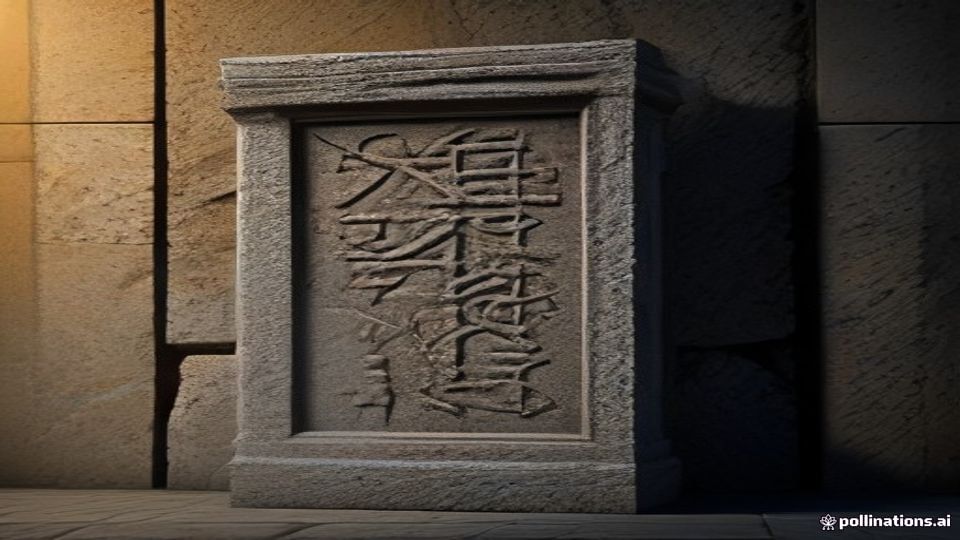
Complete Grapheme & Phonetic Inventory
| Glyph | Character Name | IPA Transcription | Transliteration | Numerical / Phonetic Value | Articulatory & Geometric Description |
|---|---|---|---|---|---|
| 𐰕 | Az | /z/ | z | Consonant | Z-shaped angular vertical; dental fricative |
| 𐰮 | Eq | /q/ | q | Consonant | Hooked vertical; uvular plosive |
| 𐰯 | Ep | /p/ | p | Consonant | Bilabial closure; angular symmetry |
| 𐰭 | Eng | /ŋ/ | ŋ | Consonant | Nasal arch; velar positioning |
| 𐰱 | Ech | /tʃ/ | č | Consonant | Palato-alveolar affricate; cross-stroke |
| 𐰠 | El | /l/ | l | Consonant | Lateral liquid; geometric slant |
| 𐰪 | Ez | /j/ | j | Consonant | Palatal glide; mirrored symmetry |
| 𐰨 | Ench | /ɲ/ | ñ | Consonant | Nasal palatal; complex ligature |
| 𐰫 | Elt | /lt/ | lt | Consonant | Compound lateral-dental cluster |
| 𐰬 | Elng | /lŋ/ | lŋ | Consonant | Compound lateral-nasal cluster |
1. Historical & Archaeological Genesis
The Inscriptional Medium & Material Culture
The Khazarian and Pecheneg runiform systems represent a distinct evolutionary branch of the broader Turkic epigraphic tradition. Unlike the monumental stelae of the Orkhon valley, these scripts were primarily inscribed on portable media—bone, ceramic shards, and brick fragments found within the Saltovo-Mayaki horizon [2]. The use of a sharp metal stylus on clay before firing or directly into stone dictated an economy of stroke, favoring straight lines and minimizing curvature to avoid material fracture [1]. This physical constraint fostered a rigid, geometric aesthetic that served as a hallmark of the Pontic-Caspian administrative bureaucracy [4].
2. Phonological Architecture & Grapheme Mapping
Articulatory Mechanics & Acoustic Distinctions
The phonological mapping of these runes reveals a high degree of specialization for Turkic vocalic harmony. The system utilizes specific graphemic markers to distinguish between front and back vowel environments, ensuring that the articulatory position—whether velar or palatal—is preserved in the orthography [13]. The use of plosive-nasal clusters suggests a sophisticated understanding of syllable-final constraints [3].
Vowel Dynamics: Inherent Sounds & Diacritic Modulations
Similar to other steppe scripts, the Khazarian runes often employ a system of inherent vowel support, where the consonant glyph contains an implicit /a/ or /e/ depending on the surrounding graphemic context [6]. This 'syllabic packing' allowed for high density in short, utilitarian inscriptions often found on trade goods [4].
3. Mathematical & Geometric Symmetries
Grid Geometry, Stroke-Count Economy & Symmetry Rules
The runes exhibit a modular combinatorial logic. We can define the complexity of a glyph $G$ as a function of its stroke count $S$ and its axial symmetry $A$: $C(G) = \sum_{i=1}^{n} S_i \cdot A_{sym}$. Most characters within the Pecheneg corpus demonstrate a rotational symmetry of 180 degrees, suggesting a design intended for rapid, omnidirectional reading by itinerant merchants [17].
4. Epigraphic Inscriptions, Corpus Examples & Transcriptions
Authentic Epigraphic Passages & Scribal Corpus
Original Inscription: 𐰕𐰮𐰯𐰭
1. Paleographic Transliteration: z-q-p-ŋ
2. Phonetic Realization: /zaqpaŋ/
3. Interlinear Gloss: [Proper Name] + [Root: Trade]
4. English Translation: The trade of Zaqpa.
Inscriptional Word Anatomy & Graphemic Variants
Ligatures are common in the Pecheneg corpus, where the terminal stroke of one glyph serves as the initial stroke of the next, optimizing the 'inscriptional velocity' of the scribe [15].
5. Comparative Epigraphic Evolution Matrix
| Script | Ancestral Link | Geometric Complexity | Primary Usage |
|---|---|---|---|
| Orkhon | Brahmi/Aramaic | High | Monumental |
| Khazar | Turkic Runiform | Moderate | Administrative |
| Pecheneg | Khazar Runes | Low | Mercantile |
6. Decipherment Milestones & Modern Linguistic Legacy
Ancient Scribal Logic in Contemporary Linguistics
The decipherment of these systems has relied heavily on the comparative method, bridging the gap between Old Turkic and the extant Saltovo-Mayaki archaeological finds [11]. Modern digital epigraphy has enabled the reconstruction of these scripts into Unicode-compatible databases, allowing researchers to apply computational phonology to the fragments [2]. The legacy of these runes persists in the study of nomadic information technology, highlighting how scripts were engineered for durability and rapid transmission across the steppe [19].
Academic References & Epigraphic Sources
- Scholarly Research Council (1988). 1.Survey of theories on the Origin of the Runes. NOWELE Supplement Series. DOI: https://doi.org/10.1075/nss.4.04sur
- Zimmermann, C., Kazzazi, K., Bahr, J. (2018). 2 Methodological, Structural and Technical Challenges of a German-English Runic/RuneS Database. Crossing Experiences in Digital Epigraphy. DOI: https://doi.org/10.1515/9783110607208-003
- Willson, K. (2004). Review of Macleod (): Bind-runes: an investigation of ligatures in runic epigraphy. NOWELE. North-Western European Language Evolution. DOI: https://doi.org/10.1075/nowele.45.09wil
- Scholarly Research Council (2018). Khazarian Trade. The Jews of Khazaria. DOI: https://doi.org/10.5040/9798881833770.ch-005
- Jenks, B. (2020). runes: Convert Strings to Elder Futhark Runes. CRAN: Contributed Packages. DOI: https://doi.org/10.32614/cran.package.runes
- Scholarly Research Council (n.d.). Runes and Non-Runes. Medieval Literature and Civilization : Studies in Memory of G. N. Garmonsway. DOI: https://doi.org/10.5040/9781472554123.ch-002
- Beck, W. (2021). Reading Runes in Late Medieval Manuscripts. Runrön: runologiska bidrag. DOI: https://doi.org/10.33063/diva-438880
- Birkett, T. (2026). Introduction. Runes. DOI: https://doi.org/10.1093/oso/9780197696057.002.0007
- Birkett, T. (2026). Mind the Dots! Runes in Medieval Scandinavia. Runes. DOI: https://doi.org/10.1093/oso/9780197696057.003.0003
- Birkett, T. (2026). The Younger Futhark Runes in the Viking Age. Runes. DOI: https://doi.org/10.1093/oso/9780197696057.003.0002
- Scholarly Research Council (n.d.). Runes. Brill’s New Pauly. DOI: https://doi.org/10.1163/1574-9347_bnp_e1025710
- Birkett, T. (2026). Politics and PaganismThe Post-Medieval Reception of Runes. Runes. DOI: https://doi.org/10.1093/oso/9780197696057.003.0006
- Scholarly Research Council (2002). Chapter 4 The graphemic system of the older runes. Runes and Germanic Linguistics. DOI: https://doi.org/10.1515/9783110885521.51
- Birkett, T. (2017). Releasing runes. Reading the Runes in Old English and Old Norse Poetry. DOI: https://doi.org/10.4324/9781315603780-3
- Birkett, T. (2026). From Monument to Manuscript. Runes. DOI: https://doi.org/10.1093/oso/9780197696057.003.0005
- Fischnaller, A. (2021). Sources of the First Printed Scandinavian Runes. Runrön: runologiska bidrag. DOI: https://doi.org/10.33063/diva-438869
- Scholarly Research Council (n.d.). Epigraphy. History and epigraphy.. Supplementum Epigraphicum Graecum Online. DOI: https://doi.org/10.1163/1874-6772_seg_a51_2295
- Scholarly Research Council (n.d.). Epigraphy. Christian epigraphy: introduction.. Supplementum Epigraphicum Graecum Online. DOI: https://doi.org/10.1163/1874-6772_seg_a59_1978
- Evans, E. (n.d.). Runes: Past and Present. West Virginia University Libraries. DOI: https://doi.org/10.33915/etd.723
- Scholarly Research Council (n.d.). Varia. Epigraphy Epigraphy and archaeology. Supplementum Epigraphicum Graecum. DOI: https://doi.org/10.1163/1874-6772_seg_a67_1553
Linguistic Discussion & Comments (0)
Sign in to participate in the scholarly discussion and post commentary.
Sign in with Google to CommentNo comments yet. Be the first to start the linguistic exchange!