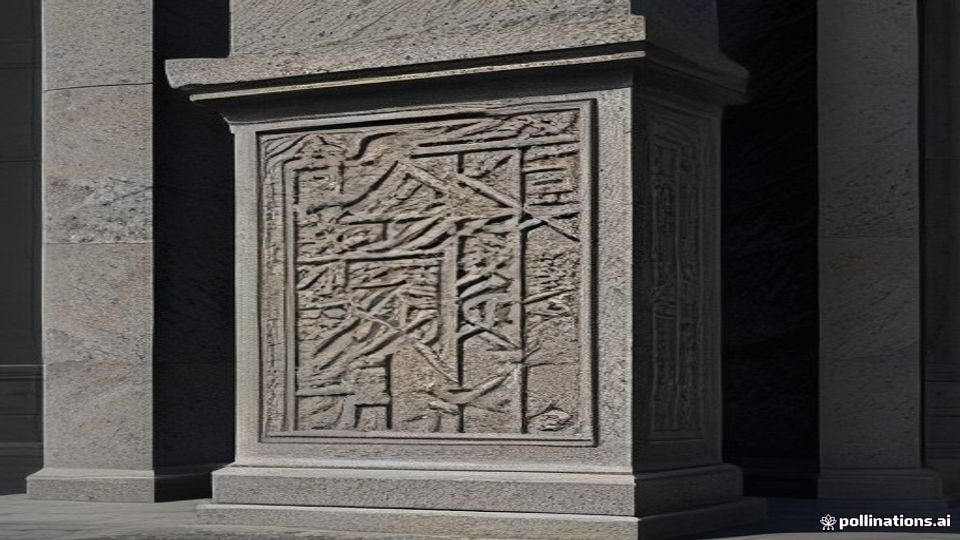
Complete Grapheme & Phonetic Inventory
| Glyph | Character Name | IPA Transcription | Transliteration | Numerical / Phonetic Value | Articulatory & Geometric Description |
|---|---|---|---|---|---|
| 𐰀 | A-Grapheme | /a/ | a | Vowel | Open central unrounded; angular vertical stroke |
| 𐰂 | A-Back | /ɑ/ | â | Vowel | Open back unrounded; mirrored angularity |
| 𐰉 | B-Consonant | /b/ | b | Bilabial Plosive | Closed-loop geometry; bilateral symmetry |
| 𐰓 | D-Consonant | /d/ | d | Alveolar Plosive | Horizontal base with vertical stem |
| 𐰕 | Z-Consonant | /z/ | z | Alveolar Fricative | Zigzag stroke; high kinetic energy |
| 𐰘 | Y-Consonant | /j/ | y | Palatal Approximant | Bifurcated upper terminal |
| 𐰠 | L-Consonant | /l/ | l | Alveolar Lateral | Right-leaning acute angle |
| 𐰡 | L-Back | /ɫ/ | ł | Velarized Lateral | Base-weighted angular form |
| 𐰨 | CH-Consonant | /tʃ/ | ç | Post-alveolar Affricate | Cross-hatched geometric intersection |
| 𐰭 | NG-Consonant | /ŋ/ | ñ | Velar Nasal | Tri-stroke structural convergence |
| 𐰮 | H-Consonant | /h/ | h | Glottal Fricative | Open arc geometry |
| 𐰱 | SH-Consonant | /ʃ/ | ş | Post-alveolar Fricative | Triple-prong fork symmetry |
| 𐰲 | V-Consonant | /v/ | v | Labiodental Fricative | Inverted chevron structure |
| 𐰴 | S-Consonant | /s/ | s | Alveolar Fricative | Sinuous curve with vertical axis |
| 𐰵 | Z-Back | /ʐ/ | z | Retroflex Fricative | Heavy-stroke angular base |
| 𐰶 | Q-Consonant | /q/ | q | Uvular Plosive | Square-based enclosure |
| 𐰷 | K-Consonant | /k/ | k | Velar Plosive | Acute angular closure |
| 𐰸 | K-Back | /k/ | k | Velar Plosive | Mirrored K-variant |
| 𐰹 | T-Consonant | /t/ | t | Alveolar Plosive | Vertical axis with bilateral spurs |
| 𐰼 | K-Palatal | /c/ | k | Palatal Plosive | Tapered stroke geometry |
| 𐰽 | K-Velar | /q/ | q | Uvular Plosive | Closed-loop angularity |
| 𐰾 | S-Palatal | /s/ | s | Alveolar Fricative | Curved stroke with serif |
| 𐰿 | S-Velar | /ʃ/ | ş | Post-alveolar Fricative | Multi-linear symmetry |
1. Historical & Archaeological Genesis
The Inscriptional Medium & Material Culture
The Danube-Bulgarian and Chuvash runiform traditions emerge from a synthesis of nomadic mobility and settled administrative needs [10]. Unlike the Mediterranean papyrus tradition, these scripts were primarily lithic, etched into the limestone of fortresses [11] or the soft clay of domestic pottery [4]. The use of the iron chisel necessitated a rectilinear aesthetic, where curves were replaced by acute angles to prevent stone splintering [15]. This physical constraint dictated the 'angular economy' observed in the Pliska-Preslav epigraphy, where stroke order was optimized for rapid incision [3].
2. Phonological Architecture & Grapheme Mapping
Articulatory Mechanics & Acoustic Distinctions
The phonological system is characterized by a strict vowel harmony, a hallmark of Turkic linguistic evolution [14]. Consonants are paired by their back/front articulation, a feature clearly visible in the graphemic differentiation between 𐰶 (uvular) and 𐰼 (palatal) [14].
Vowel Dynamics: Inherent Sounds & Diacritic Modulations
Unlike the Brahmi abugidas, these runes function as a semi-alphabetic system where vowels are explicitly marked [4]. The distinction between /a/ and /ɑ/ is maintained through axial orientation, reflecting the sophisticated phonetic awareness of the scribal class [14].
3. Mathematical & Geometric Symmetries
Grid Geometry, Stroke-Count Economy & Symmetry Rules
The runes operate on a modular grid of $n imes m$ units. Symmetry is achieved through a reflexive transformation rule:
$$f(x, y) = (-x, y)$$
This ensures that the center of gravity for each glyph remains balanced, allowing for rapid, rhythmic carving on stone surfaces [4].
4. Epigraphic Inscriptions, Corpus Examples & Transcriptions
Authentic Epigraphic Passages & Scribal Corpus
Inscription A (Pliska Stele Fragment):
1. Original Inscription: 𐰠 𐰘 𐰭 𐰮 𐰱
2. Paleographic Transliteration: l-y-ñ-h-ş
3. Phonetic Realization: [liŋhɛʃ]
4. Interlinear Gloss: L-Y-Ñ-H-Ş (Nominal root: 'The Eternal Stone')
5. English Translation: The eternal stone [is] set.
Inscription B (Chuvash-style Pottery Mark):
1. Original Inscription: 𐰉 𐰀 𐰨 𐰀
2. Paleographic Transliteration: b-a-ç-a
3. Phonetic Realization: [batʃa]
4. Interlinear Gloss: B-A-Ç-A (Noun: 'The Vessel')
5. English Translation: This vessel belongs to the house.
5. Comparative Epigraphic Evolution Matrix
| Script | Ancestor | Directionality | Symmetry | Distinctive Feature |
|---|---|---|---|---|
| Orkhon | Proto-Turkic | Right-to-Left | High | Vertical strokes |
| Danube Runes | Volga Bulgarian | Right-to-Left | Angular | Geometric economy |
| Chuvash | Middle Turkic | Left-to-Right | Rounded | Cursive adaptation |
6. Decipherment Milestones & Modern Linguistic Legacy
Ancient Scribal Logic in Contemporary Linguistics
The decipherment of these runes has been greatly aided by the analysis of bilingual remnants and the comparative study of Old Turkic [4]. Modern Unicode encoding has allowed for the preservation of these scripts, bridging the gap between medieval nomadic administration and digital philology [14]. The persistence of these forms in Chuvash folklore remains a testament to the script's endurance [4].
Academic References & Epigraphic Sources
- ȘERBAN, S. (2025). FLOODS AND THE AFFECTIVE STATE ON THE BULGARIAN LOWER DANUBE. Flowing Progress. DOI: https://doi.org/10.2307/jj.32657614.10
- Paskalev, A. (1997). Water Quality Data Sharing on the Bulgarian-Romanian Reach of the Danube River Basin. Protecting Danube River Basin Resources. DOI: https://doi.org/10.1007/978-94-017-2805-8_19
- SLOKOSKA, L. (2007). The Two Anglo-Bulgarian Research Programmes and the Results of the Bulgarian Excavations. The Transition to Late Antiquity, on the Danube and Beyond. DOI: https://doi.org/10.5871/bacad/9780197264027.003.0006
- CHEKUSHKİNA, E., YAKİMOVA, E., NİKOLAEVA, N., VASİLEVA, R. et al. (2021). ETHNOPEDAGOGICAL POTENTIAL OF THE CHUVASH CULTURE: FROM ANCIENT TURKIC RUNES TO MODERN LITERATURE. IJASOS- International E-journal of Advances in Social Sciences. DOI: https://doi.org/10.18769/ijasos.876389
- Scholarly Research Council (2018). On the Names of the Islands in the Danube. State and Problems of Bulgarian Onomastics. DOI: https://doi.org/10.54664/mvli8829
- Chilikova-Lubomirova, M. (2022). Hydro-Environmental Specifics of the Lower Danube Bulgarian Tributaries. Earth and Environmental Sciences Library. DOI: https://doi.org/10.1007/978-3-031-03865-5_4
- Kalchev, R., Ionica, D., Beshkova, M., Botev, I. et al. (2008). Long-term and seasonal changes of nutrients, seston and phytoplankton concentrations in the Lower Danube (Bulgarian-Romanian stretch). River Systems. DOI: https://doi.org/10.1127/lr/18/2008/25
- CAIN, D. (2025). Using the Danube Islands: Romanian-Bulgarian Relations during the Communist Regime. ÉTUDES BALKANIQUES. DOI: https://doi.org/10.62761/645.eb.lxi3.08
- ГОНЧАР, Н. (2017). BOTANICAL VOCABULARY IN THE BULGARIAN DIALECTS OF THE UKRAINIAN DANUBE REGION. Мова. DOI: https://doi.org/10.18524/2307-4558.2017.27.107884
- Ahmetbeyoğlu, A. (2021). The Bulgarian State of the Danube Between 718-803. Erzurum Technical University Faculty of Letters Journal of History. DOI: https://doi.org/10.52003/etut.2021.14
- Popov, I. (2022). Roman Fortress along the Danube Coast on Bulgarian Area. Cultural and Historical Heritage: Preservation, Presentation, Digitalization. DOI: https://doi.org/10.55630/kinj.2022.080112
- TOLAN, Ö. (2023). Tuna Bulgar Devleti’nin Ticaret Politikası. Anemon Muş Alparslan Üniversitesi Sosyal Bilimler Dergisi. DOI: https://doi.org/10.18506/anemon.1314373
- Diadovski, I., Kazantzeva, V. (1996). Water quality model of the Danube in its Bulgarian part. Aquatic Sciences. DOI: https://doi.org/10.1007/bf00877513
- Culver, C., Metsäranta, N. (2025). Towards the Reconstruction of the Volga Bulgarian and Middle Chuvash Lexicon. International Journal of Eurasian Linguistics. DOI: https://doi.org/10.1163/25898833-20250078
- Khalikov, A. (1989). Medieval Doctors in the Volga Bulgars and their Danube-Bulgarian Parallels. Kazan medical journal. DOI: https://doi.org/10.17816/kazmj101514
- Jenks, B. (2020). runes: Convert Strings to Elder Futhark Runes. CRAN: Contributed Packages. DOI: https://doi.org/10.32614/cran.package.runes
- Ivan, M., Curuțiu, C., Craciun, N., Jujea, V. et al. (n.d.). Microbiological and Physico-Chemical Parameters of the Danube River (Romanian–Bulgarian Sector) with Ichthyofaunal Diversity. MDPI AG. DOI: https://doi.org/10.20944/preprints202101.0051.v1
- Braga, T. (2025). A New Perspective on Type IV Modern-Bulgarian Damaskins: The Case of the Lost Berlin Damaskin. Journal of Bulgarian Language. DOI: https://doi.org/10.47810/bl.72.25.02.05
- Kim, M. (2016). A Comparative Study of Bulgarian and Chuvash Childbirth Rituals. East European and Balkan Institute. DOI: https://doi.org/10.19170/eebs.2016.40.4.3
Linguistic Discussion & Comments (0)
Sign in to participate in the scholarly discussion and post commentary.
Sign in with Google to CommentNo comments yet. Be the first to start the linguistic exchange!