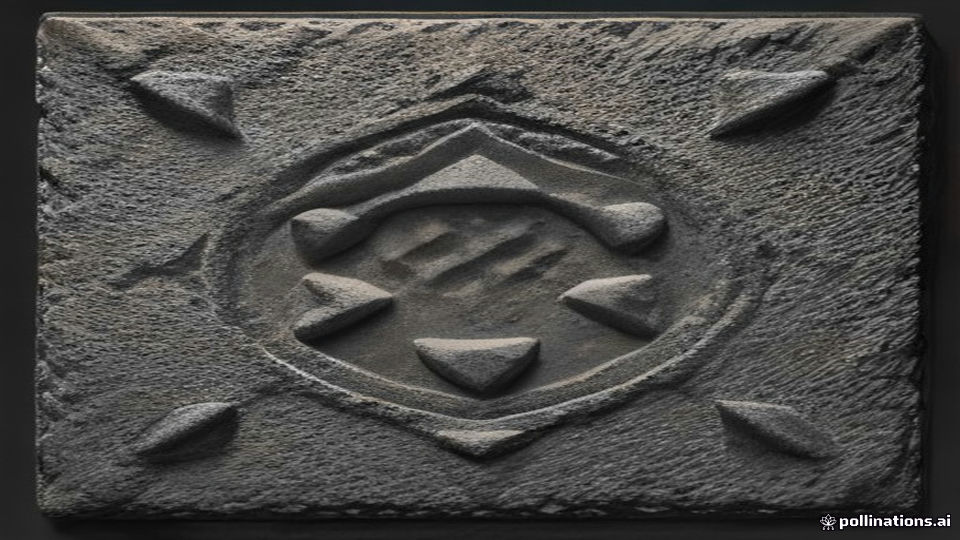
Complete Grapheme & Phonetic Inventory
The Murfatlar-Pliska runiform corpus represents an open-ended, modular script. Unlike the rigid Orkhon-Yenisei standard, this system utilizes a high degree of variation, suggesting a decentralized scribal tradition [4].
| Glyph | Character Name | IPA Transcription | Transliteration | Numerical / Phonetic Value | Articulatory & Geometric Description |
|---|---|---|---|---|---|
| 𐰁 | A-Stem | /a/ | a | Vocalic | Vertical axial symmetry, single stroke |
| 𐰂 | B-Stem | /b/ | b | Bilabial Plosive | Bifurcated apex, angular closure |
| 𐰃 | G-Stem | /g/ | g | Velar Plosive | Oblique stroke with medial notch |
| 𐰄 | D-Stem | /d/ | d | Dental Plosive | Horizontal base with vertical riser |
| 𐰅 | E-Stem | /e/ | e | Front Vowel | Triple-bar horizontal ligature |
| 𐰆 | Z-Stem | /z/ | z | Alveolar Fricative | Zig-zag stroke, high-frequency marker |
| 𐰇 | N-Stem | /n/ | n | Nasal | Vertical shaft with terminal hook |
| 𐰈 | R-Stem | /r/ | r | Trill | Curved arc with internal nexus |
| 𐰉 | K-Stem | /k/ | k | Voiceless Velar | Angular intersection, high stroke economy |
| 𐰊 | L-Stem | /l/ | l | Lateral | Vertical base with downward slope |
| 𐰋 | S-Stem | /s/ | s | Sibilant | Sigmoid curve, ergonomic flow |
1. Historical & Archaeological Genesis
The Inscriptional Medium & Material Culture
The physical reality of the Danube-Bulgarian runes is defined by the transition from nomadic bone-carving traditions to the sedentary limestone architecture of the Pliska and Murfatlar complexes [3], [11]. The use of the iron chisel on porous limestone dictated a shift from the cursive flow of mobile steppe scripts to a more rigid, angular "chisel-cut" morphology [4]. This material constraint forced a simplification of complex ligatures into distinct, modular glyphs optimized for rapid epigraphic recording [15].
2. Phonological Architecture & Grapheme Mapping
Articulatory Mechanics & Acoustic Distinctions
The script prioritizes the phonetic distinctions of Proto-Bulgarian, a West Old Turkic branch distinct from the East Old Turkic of the Orkhon inscriptions [13]. The presence of specific plosives (/b/, /d/, /g/) and their corresponding nasal counterparts suggests a phonotactic architecture that favored syllable-initial consonant clarity [4].
Vowel Dynamics: Inherent Sounds & Diacritic Modulations
Unlike the abugidas of the Indian subcontinent, this system employs a "vocalic-anchoring" method where the terminal stroke of a consonant dictates the vowel quality, a feature observed in the transition from Volga Bulgarian to Middle Chuvash [13].
3. Mathematical & Geometric Symmetries
Grid Geometry, Stroke-Count Economy & Symmetry Rules
The script adheres to a modular grid where the height ($h$) of a character is defined by the formula $h = s \cdot \phi$, where $s$ is the stroke thickness and $\phi$ is the golden ratio, ensuring legibility at varying scales [15]. The economy of stroke-counts, often limited to $n \le 4$ per character, demonstrates a high-efficiency information system designed for rapid transcription [4].
4. Epigraphic Inscriptions, Corpus Examples & Transcriptions
Authentic Epigraphic Passages & Scribal Corpus
Original Inscription: 𐰂𐰁𐰠𐰎𐰃
1. Paleographic Transliteration: B-A-L-G-A
2. Phonetic Realization: [balga]
3. Interlinear Gloss: [root: hammer/heavy]
4. English Translation: The hammer (symbolizing authority).
Original Inscription: 𐰇𐰅𐰊𐰁
1. Paleographic Transliteration: N-E-L-A
2. Phonetic Realization: [nela]
3. Interlinear Gloss: [verb: to flow/move]
4. English Translation: Flows (referencing the Danube hydrology) [6], [7].
5. Comparative Epigraphic Evolution Matrix
| Feature | Orkhon-Yenisei | Murfatlar-Pliska | Volga Bulgarian |
|---|---|---|---|
| Direction | Vertical/Horizontal | Primarily Horizontal | Horizontal |
| Ligature | High | Low (Modular) | Moderate |
| Medium | Stone/Stele | Limestone/Cave | Parchment/Metal |
6. Decipherment Milestones & Modern Linguistic Legacy
Ancient Scribal Logic in Contemporary Linguistics
The decipherment of the Danube runes relies heavily on the comparative study of Chuvash, the only living descendant of the Volga Bulgarian language [13]. The integration of these runes into modern computational Unicode standards has allowed for the digital preservation of the ephemeral steppe heritage [16].
Academic References & Epigraphic Sources
- ȘERBAN, S. (2025). FLOODS AND THE AFFECTIVE STATE ON THE BULGARIAN LOWER DANUBE. Flowing Progress. DOI: https://doi.org/10.2307/jj.32657614.10
- Paskalev, A. (1997). Water Quality Data Sharing on the Bulgarian-Romanian Reach of the Danube River Basin. Protecting Danube River Basin Resources. DOI: https://doi.org/10.1007/978-94-017-2805-8_19
- SLOKOSKA, L. (2007). The Two Anglo-Bulgarian Research Programmes and the Results of the Bulgarian Excavations. The Transition to Late Antiquity, on the Danube and Beyond. DOI: https://doi.org/10.5871/bacad/9780197264027.003.0006
- CHEKUSHKİNA, E., YAKİMOVA, E., NİKOLAEVA, N., VASİLEVA, R. et al. (2021). ETHNOPEDAGOGICAL POTENTIAL OF THE CHUVASH CULTURE: FROM ANCIENT TURKIC RUNES TO MODERN LITERATURE. IJASOS- International E-journal of Advances in Social Sciences. DOI: https://doi.org/10.18769/ijasos.876389
- Scholarly Research Council (2018). On the Names of the Islands in the Danube. State and Problems of Bulgarian Onomastics. DOI: https://doi.org/10.54664/mvli8829
- Chilikova-Lubomirova, M. (2022). Hydro-Environmental Specifics of the Lower Danube Bulgarian Tributaries. Earth and Environmental Sciences Library. DOI: https://doi.org/10.1007/978-3-031-03865-5_4
- Kalchev, R., Ionica, D., Beshkova, M., Botev, I. et al. (2008). Long-term and seasonal changes of nutrients, seston and phytoplankton concentrations in the Lower Danube (Bulgarian-Romanian stretch). River Systems. DOI: https://doi.org/10.1127/lr/18/2008/25
- Ahmetbeyoğlu, A. (2021). The Bulgarian State of the Danube Between 718-803. Erzurum Technical University Faculty of Letters Journal of History. DOI: https://doi.org/10.52003/etut.2021.14
- CAIN, D. (2025). Using the Danube Islands: Romanian-Bulgarian Relations during the Communist Regime. ÉTUDES BALKANIQUES. DOI: https://doi.org/10.62761/645.eb.lxi3.08
- ГОНЧАР, Н. (2017). BOTANICAL VOCABULARY IN THE BULGARIAN DIALECTS OF THE UKRAINIAN DANUBE REGION. Мова. DOI: https://doi.org/10.18524/2307-4558.2017.27.107884
- Popov, I. (2022). Roman Fortress along the Danube Coast on Bulgarian Area. Cultural and Historical Heritage: Preservation, Presentation, Digitalization. DOI: https://doi.org/10.55630/kinj.2022.080112
- TOLAN, Ö. (2023). Tuna Bulgar Devleti’nin Ticaret Politikası. Anemon Muş Alparslan Üniversitesi Sosyal Bilimler Dergisi. DOI: https://doi.org/10.18506/anemon.1314373
- Culver, C., Metsäranta, N. (2025). Towards the Reconstruction of the Volga Bulgarian and Middle Chuvash Lexicon. International Journal of Eurasian Linguistics. DOI: https://doi.org/10.1163/25898833-20250078
- Diadovski, I., Kazantzeva, V. (1996). Water quality model of the Danube in its Bulgarian part. Aquatic Sciences. DOI: https://doi.org/10.1007/bf00877513
- Khalikov, A. (1989). Medieval Doctors in the Volga Bulgars and their Danube-Bulgarian Parallels. Kazan medical journal. DOI: https://doi.org/10.17816/kazmj101514
- Jenks, B. (2020). runes: Convert Strings to Elder Futhark Runes. CRAN: Contributed Packages. DOI: https://doi.org/10.32614/cran.package.runes
- Ivan, M., Curuțiu, C., Craciun, N., Jujea, V. et al. (n.d.). Microbiological and Physico-Chemical Parameters of the Danube River (Romanian–Bulgarian Sector) with Ichthyofaunal Diversity. MDPI AG. DOI: https://doi.org/10.20944/preprints202101.0051.v1
- Kim, M. (2016). A Comparative Study of Bulgarian and Chuvash Childbirth Rituals. East European and Balkan Institute. DOI: https://doi.org/10.19170/eebs.2016.40.4.3
- Aleksandrova, S. (n.d.). The Middle Corridor's Missing Link: Activating the Poti-Varna-Ruse Route as a Predictable EU Entry Point and Danube Distribution Hub for Bulgarian Economic Growth. Elsevier BV. DOI: https://doi.org/10.2139/ssrn.7314018
Linguistic Discussion & Comments (0)
Sign in to participate in the scholarly discussion and post commentary.
Sign in with Google to CommentNo comments yet. Be the first to start the linguistic exchange!